
Accounting and Bookkeeping
5 min read

How Much Does Outsourced Bookkeeping Cost in 2026?

Outsourced bookkeeping costs vary depending on business size, transaction volume, and service scope. This guide explains typical pricing models and what businesses can expect to pay in 2026.
Overview

For many business owners, bookkeeping starts as a do-it-yourself task and slowly becomes a bottleneck. As transactions increase and decisions become more complex, the question shifts from "Can I manage this myself?" to "What will it cost to outsource this properly?" In 2026, outsourced bookkeeping remains one of the most cost-effective ways to build a reliable financial foundation. Still, pricing varies based on your business size, activity level, and the kind of support you need. Understanding how bookkeeping pricing works in the U.S. market can help you set expectations and choose the right solution. This guide breaks down typical U.S. outsourced bookkeeping cost, what drives those prices, and how to evaluate value beyond the monthly fee.

What Drives Outsourced Bookkeeping Cost?

There is no universal rate for outsourced bookkeeping. Pricing is shaped by a few practical factors:
  • Monthly transaction volume
  • Number of bank and credit card accounts
  • Revenue streams and business complexity
  • Payroll and bill pay needs
  • Frequency and depth of reporting
  • Level of advisory or support required

A solo consultant with 50 transactions a month has very different needs than a multi-location business processing hundreds of payments, refunds, and expenses. Most bookkeeping outsourcing providers reflect this difference through tiered plans rather than hourly billing. This makes costs predictable and aligned with workload.
Outsourced Bookkeeping Cost in the US

What Does Hiring an In-House Bookkeeper Cost in the U.S.?

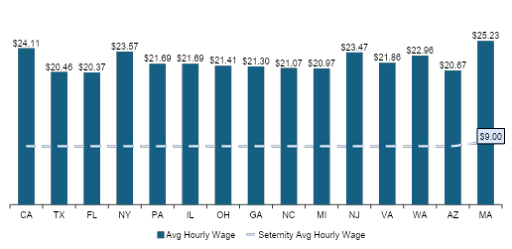
The chart above shows the average hourly wage for bookkeepers across major U.S. states, based on data from the 2024 U.S. Bureau of Labor Statistics. These figures reflect base wages only and do not include benefits, payroll taxes, onboarding time, turnover risk, or periods of idle capacity. For context, the dashed line represents Seternity's average effective hourly cost of $9. Even before accounting for overhead, in-house bookkeeping wages range from roughly $20 to $25 per hour across most states. Once benefits, management time, and downtime are considered, the true cost of an internal hire is materially higher than what appears on a paycheck. This is why many small and mid-sized businesses shift toward outsourced models as transaction volume grows. The decision is not only about labor rates. It is about converting a fixed, capacity-based cost into a variable, workload-based one. Instead of paying for availability, companies pay for output.

How Providers Structure Bookkeeping Pricing

Most U.S. firms use one of three models:
  1. Fixed Monthly Packages: The most common approach. Pricing is based on transaction volume and complexity, giving you a predictable monthly fee.
  2. Usage-Based Tiers: Costs scale as activity increases. This is common for ecommerce and seasonal businesses where volume fluctuates.
  3. Custom Plans for Larger Businesses: Multi-entity or high-growth companies often receive tailored pricing based on workload and reporting needs. Reputable providers review your data before quoting so pricing reflects reality rather than guesswork.

Is Outsourced Bookkeeping Worth the Cost?

The value of bookkeeping outsourcing goes beyond time savings. It delivers:
  • Cleaner and more accurate books
  • Faster month-end close
  • Clear visibility into cash flow
  • Readiness for taxes, audits, or fundraising
  • Less stress and fewer surprises

Messy books lead to missed deductions, delayed filings, and reactive decisions. Those hidden costs often exceed the entire annual spend on outsourced bookkeeping. Seen this way, bookkeeping pricing becomes an investment in operational clarity rather than a simple expense.

The Bottom Line

In 2026, outsourced bookkeeping cost in the U.S. typically ranges from a few hundred dollars per month for small businesses to a few thousand for high-volume or complex operations. Pricing is tiered based on transaction volume, complexity, and the level of support required. Compared to hiring in-house, bookkeeping outsourcing remains one of the most efficient ways to build a strong financial backbone. With predictable pricing and professional oversight, businesses gain accuracy, visibility, and confidence without adding headcount. For many owners, the real question is not whether to outsource, but how long they can afford to wait.

Get In Touch

Partner with experts who
understand your financial vision

Let’s discuss how our consulting solutions can help you plan smarter, grow stronger, and achieve lasting success.

WhatsApp