
Outsourcing Business Development: Benefits and Use Cases
Business development is the engine of growth. It creates relationships, opens doors, and builds the pipeline that fuels revenue. But executing it well takes time, discipline, and consistency. For many organizations, especially growing ones, building and managing an in-house business development function is harder than it looks.

Overview
This is why more companies are turning to outsourced business development.
Outsourcing allows teams to scale outreach, improve follow-up, and introduce structure without building everything from scratch. When combined with business development automation and modern sales automation tools, it transforms growth from an ad hoc effort into a repeatable system.
In this guide, we explore what outsourced business development looks like, its key benefits, and where it delivers the most impact.
What Is Outsourced Business Development?
- Lead research and list building
- Outreach via email, phone, and LinkedIn
- Follow-up and nurturing
- Meeting scheduling
- CRM updates and pipeline tracking
- Campaign design and optimization
Rather than replacing internal sales or leadership, outsourced teams act as an extension of your organization. They focus on creating qualified conversations so your core team can focus on closing and relationship depth.
For many companies, this model bridges the gap between ambition and capacity.
Key Benefits of Outsourced Business Development
- Faster Time to Pipeline: Building an internal BD function requires hiring, training, and iteration. Outsourced business development teams arrive with proven workflows, tools, and experience. Campaigns can launch in weeks rather than months.
- Lower Fixed Cost: Instead of committing to full-time headcount, outsourcing converts business development into a variable expense. This reduces risk and preserves flexibility, especially in early growth stages.
- Access to Process and Expertise: Good business development is not just about sending messages. It requires targeting, sequencing, personalization, and measurement. Outsourced teams bring playbooks built across industries. They understand what works and how to adapt quickly.
- Built-In Automation: Most providers operate on modern stacks that include CRM integration, sequencing tools, and analytics. This embeds business development automation from day one. Follow-ups happen automatically. Activity is logged. Performance is visible.
- Focus for Internal Teams: With pipeline generation handled externally, internal leaders and sellers can focus on strategy, closing, and relationships. Effort shifts from chasing leads to advancing deals.
The Role of Sales Automation
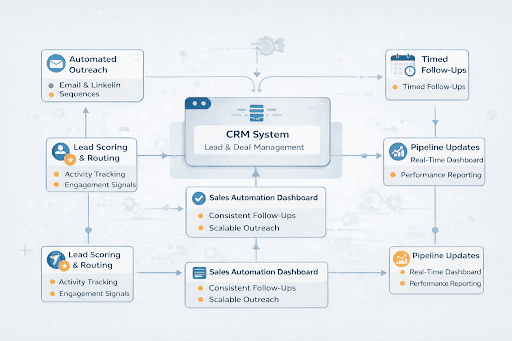
- Multi-touch outreach sequences
- Timed follow-ups
- Lead scoring and routing
- Real-time pipeline visibility
- Performance tracking by channel and rep
These systems remove manual friction. They ensure consistency across hundreds or thousands of interactions.
Sales automation turns business development into an operating system rather than a set of tasks.
Common Use Cases
- Early-Stage Companies: Startups use it to validate markets and build initial traction without hiring full teams.
- B2B Services and Consulting: Firms rely on outsourced BD to maintain steady deal flow while partners focus on delivery.
- Enterprise Expansion: Larger organizations use it to enter new geographies or verticals quickly.
- Partnership-Led Growth: Teams use outsourcing to manage long-cycle relationship development with banks, brokers, or channel partners.
- High-Volume Outbound: When scale matters, external teams combined with automation can reach far more prospects than internal teams alone.
When Outsourcing Makes the Most Sense
- You need pipeline quickly
- Internal bandwidth is limited
- You want predictable outreach
- Markets are new or untested
- Headcount risk is a concern
It provides momentum without permanence.