
What Is a Virtual CFO and How Does It Work?
As a business grows, financial decisions become more complex. Cash flow matters more. Forecasts start driving strategy. Investors ask harder questions. At some point, basic bookkeeping is no longer enough.
Overview
That is when many founders realize they need a CFO.
But hiring a full-time Chief Financial Officer is expensive and often premature for small and mid-sized businesses. This gap is where virtual CFO services come in.
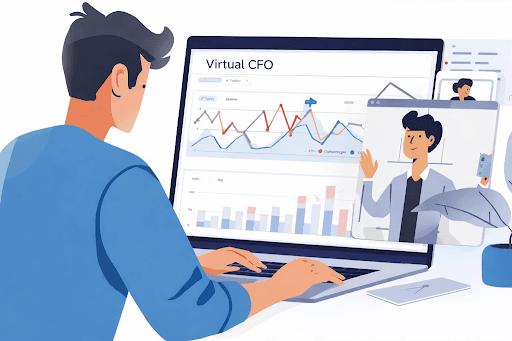
A virtual CFO, often referred to as a fractional CFO, gives companies access to senior financial leadership without the cost or commitment of a full-time executive. It is a flexible way to bring strategic finance into the business exactly when it is needed.
In this guide, we explain what a virtual CFO is, how the model works, and when it makes sense for growing companies.
What Is a Virtual CFO?
- Financial planning and forecasting
- Cash flow management
- Budgeting and performance tracking
- Strategic advisory for growth
- Investor and lender preparation
- KPI design and reporting
- Scenario and risk analysis
Unlike a bookkeeper or accountant, a fractional CFO focuses on direction, not just records. Their role is to help you understand what the numbers mean and how to act on them.
They sit between day-to-day accounting and long-term strategy.
How Virtual CFO Services Work
The process usually looks like this:
- Financial Baseline: The virtual CFO reviews your current financials, systems, and reporting. This includes profit and loss statements, cash flow history, balance sheet structure, existing forecasts, and accounting processes. The goal is to establish a clean, reliable starting point.
- Planning and Modeling: Next, the fractional CFO builds forward-looking models. These often include revenue forecasts, hiring plans, cash runway analysis, scenario modeling, and capital needs planning. This turns your business plan into a financial roadmap.
- Ongoing Guidance: On an ongoing basis, virtual CFO services provide monthly or quarterly reviews, variance analysis against plan, strategic input on major decisions, support for fundraising or financing, and board and investor reporting.
Instead of reacting to numbers after the fact, you start managing the business proactively.

When a Fractional CFO Makes Sense
- Revenue is growing but cash feels unpredictable
- You are preparing for fundraising
- You need to understand unit economics
- You are hiring and scaling
- Decisions carry higher financial risk
- Founders need clarity, not just reports
Most companies do not need a full-time CFO until they reach significant scale. But many need CFO-level thinking far earlier.
That is the role of a fractional CFO.
Virtual CFO vs In-House CFO
| Area | Virtual CFO Services | Full-Time CFO |
|---|---|---|
| Cost | Fraction of full-time salary | High fixed compensation |
| Commitment | Flexible, scalable | Long-term |
| Speed | Fast onboarding | Lengthy hiring |
| Best For | SMBs and growing teams | Larger, complex organizations |
| Focus | Strategy and clarity | Strategy plus full-time execution |
Virtual CFO services allow businesses to access senior financial leadership without overbuilding too early.
The Bottom Line
For growing businesses, a fractional CFO is often the bridge between basic accounting and a fully built finance function.
It is not about replacing a future hire, it is about making better decisions today.